Showing posts with label Mozambique. Show all posts

Monday, September 13, 2010

Onwards to Malawi

like playing a character in the African Queen - sailing to Malawi on the Ilala ferry

One thing i have failed in either vaccinating against or preventative medicine is for cold and flu. I spend the evening blowing snot from my face and by 5am next morning my throat is in rebellion too.

The Ilala steamboat plies the waters of Lake Malawi in alternating directions twice a week. Built in Glasgow in 1947 it has been in service ever since. How you manage to get a steamboat into the African interior seems so improbable, but shipped and carried by hand overland in parts. It was then reassembled in Monkey Bay in the southern part of Lake Malawi.

The Ilala ferry no longer docks on the shore of Cobue, but stops off at Likoma island. Tuesdays it sails to Monkey Bay, but i opt for the Saturday sailing to Nkarta Bay – if nothing else to find an ATM and stock up on Kwacha – the Malawian currency.

Taking a public sailing at 7am across from Cobue to Likoma it is a two hour crossing and cost Mtc200. The Immigration Officer comes down to “greet me” on the beach, gives me the full 30 day visa and tells me that the Ilala ferry will be arriving between 5pm and 10pm.

As i head off to explore the town and kill several hours, i am invited into the office/home of Lester, a Malawian local who has just signed a second 7 year contract with the Lake Milawi Project, an NGO established by a British Buddhist guy who spent three years teaching at the local school. The project is manifold including IT Training, AIDS and HIV support work, and Lester’s great passion, sustainable subsistence agriculture.

I have always got time for visionaries who seek the betterment of others, and Lester certainly falls into this category.

He gives lectures in local community halls and also tries to lead by example, having recently begun growing tomatoes, potatoes and carrots in an enclosed patch of the beach using compost to enrich the sand.

Lester is eloquent in English and offers several interesting if depressing insights into the corruption, nepotism and bribery throughout the country. He helps change my remaining Meticas into Kwacha, takes me to the Hungry Clinic, a good local restaurant and invites me to generally hang-out and chew the fat. Clearly very honest and sincere, he is known and clearly respected by everyone – a pillar of a society that still cares about pillars.

Likoma would be recommended a stop-over with a few lodges at a variety of prices, an interesting cathedral and some of cheapest diving to be had in Africa.

Rumours abound that the boat is running late and i tell Lester i’ll head over to the dock to wait patiently. He’ll have none of it saying i am his responsibility. This may be just as well, for by this stage i am floating in and out of fever. Lester insists we will hear the ferry dock as we grab a coke at the aerodrome, but by 10.30 i am anxious and a pal drives us to the ferry terminal - a small cove and beach landing.

It is complete pitch and whilst one senses a small crowd around, it’s pretty impossible to see much. The ferry finally comes into view at 11.30pm and anchors some 1000 metres offshore by 12.30. A flotilla of small transfer boats, both engine and paddle powered start the transfer of what transpires to be the multitudes laden with boxes and crates. It’s a complete shambles as crowds scramble and scream into the darkness, with children and babies wailing in tow. Again i thank Lester and tell him to go home, but he will have none of it. We patiently for about hour before inching forward to the transfer crafts. Wade heavy with both people and cargo i notice that the water line is scarily low and although perched at the front top end, i can feel my ass getting wet. Lester carries my rucksack whilst i carry my “day pack” (The Beast, Computer, MP3 player and notebook – it weighs as much as the backpack).

We pull up against the Ilala and meet pandemonium. It is complete mayhem with boxes, crates and people scattered all over. It takes some 10 minutes to navigate to the upper level of the boat whilst playing contortionist, bucking and twisting and trying to avoid smashing my head into the low ceiling as i clamber inexpertly around boxes and limbo under railings. Finally arriving on the upper deck, it is cold and no sign of any mattress hire as mentioned by Lonely Planet.

Fortunately and not surprisingly, Lester knows one of the deck-hands and procures me a key to Cabin 1. The room is small and somewhat aged, but it feels like heaven, especially whilst i feel like crap. Whilst waiting to set sail, i make the most of the sink and hot water for a shave. We finally hoist anchor at 3.30am.

my own cabin - a great place to combat fever

I ask twice to purchase the ticket and i am told someone will be around to collect the money. He finally shows up at 9.15am and charges a whopping K7230 (almost US$40!). However a cabin entitles one to a relatively clean toilet and hot shower area and free breakfast. Indeed the Full English is cracking (probably more so because of my desperate need for sustenance) which i enjoy leisurely during the penultimate stop before my chosen destination – Nkarta Bay. Unfortunately lunch is not free but nonetheless enjoy chicken and fries – for i have been forced to live on fish for much longer than i would have chosen.
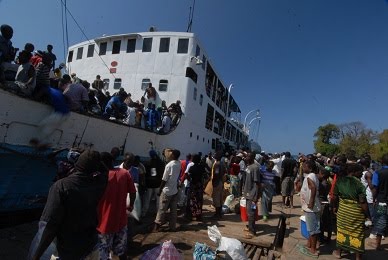
disembarkation at Nkarta Bay

off the stern of the Ilala Ferry


Ten hours after setting sail from Lekoma we finally start to disembark. With a jetty to greet passengers, this is a far less painful experience than the boarding mayhem.

Lester is always happy to meet and greet visitors and can be contacted on his Malawi cell 0993 702 058

Sunday, September 12, 2010

Departing Mozambique

As Bob Dylan once sang (from the track "Mozambique" from his album “Desire”
“I like to spend some time in Mozambique
The sunny sky is aqua blue
And all the couples dancing cheek to cheek
It’s very nice to spend a week or two”

Well Bob, all i can say is you probably saw bugger all of the country. Seven weeks has been needed to give this country justice to its exceptional beauty. It feels like i spent a week on chapas (the local mini-buses) alone to get to the further flung destinations.

Travel has been slow, hard and frustrating at times, but the pain has been so worth it.

Friday, September 10, 2010

Bribing At The Border

It’s all been a bit crazy – so appropriate for Mozambique.

There is not much to keep the travellist in Cuamba, it is mainly a transport hub. i sort out my “Bribe” money at Standard Bank (the last Standard Bank before Lake Niassa. I overnight here and head out to Lichingwa early next morning. Arriving in to this dusty town by 2pm i check out the espresso and food at the excellent Pastileria and Pandera Maria which also do good pizzas.

Up and out at 6.30am for the chapa to Metagula. Whilst only a 2 hour 20 minute journey, it takes over two hours to fill up with passengers, so whilst pulling into Metagula before 12pm there is no connection to Cobue leaving before 3pm, my penultimate destination in Mozambique.

Cobue, according to Lonely Planet Africa “sees a small but steady stream of adventure travellers”, but arriving into the groovy Khango Baech (sic) Lodge at 8pm, there is only a European couple from the German Embassy in Maputo on a two week vacation. They are very sweet and feed me bread rolls and real cheddar cheese.

the picturesque Cobue - now the Ilala fails to dock here it may well fall by the wayside.

the somewhat haunting ruined church at Cobue

Next morning the delightful and helpful Vincent from the backpackers accompanies me to the immigration officer next to the Vodacom Tower. The office is dark – there is no electricity here in town, and i am pleased to note a large box labelled “Tips Box” on one of the shelves. The large fat faced middle-age guy with gappy teeth seems jovial enough. I fill out a departure card and pass him my passport. He sees the “30 day only” like lightening and his whole face glows with delight.

“Something is wrong” he announces proudly, and turns to his calendar, counts off 17 days and multiplies on his handy calculator. He says he can help me: rather than charge me US$100 he will charge me “only Mtc1500 per day” (about US$40). However i still owe him more than Mtc25000! I say Mbane must have made a mistake and maybe he can check with them. “Impossible” he snaps with all the infallibility of the Pope. I explain i am a humble lowly student who has just a few Meticas to my name. He asks me how much i have and i count out Mtc4000 (sensibly having stowed some Mtc8000 in my hut).

“Mtc 4000 can help me to help you. Give to me.”

I then explain i need money to pay for my room, and boat to Malawi. We haggle for some 15 minutes and finally agree on Mtc2500 total. It helps me a lot, but he clearly must be a very rich man. He stamps my passport and i am suddenly legitimised again.

Walking with The Beast on the beach at sunset, i hear a rabble behind me. Some 40 odd kids (aged between 4 and 14) are chasing me. It is like some bizarre Steven King novel. They want a photo-shoot, the light is good and their village picturesque. Like most of the shoots there is mayhem, boys regularly wanting to show you kung fu moves and stray hands wandering into frame. Nonetheless some fair results are gleaned and provides for a rich afternoon entertainment for both them and myself.


Cobue has no electricity and no MCEL cell signal although Vodacom works occasionally.

Thursday, September 9, 2010

Visa Concerns

I have been keeping a low profile – well as low as a skinny 6 foot 2 Caucasian can in Mozambique.

I have already stayed more than 20 days over my 30 day visa. In theory, i would be facing a fine of US$100/day. I have opted therefore to head to the Mozambique/Malawi border where a lone immigration officer with a computer that doesn’t work. How much it is to “fix” is anyone’s guess. Predictions please?

Wednesday, September 8, 2010

Time To Take The Train - Nampula to Cuamba

The hustle and bustle along the railway track - a moving market

Departing Nampula, there is a train running to Cuamba. Trains depart daily (except possibly Sunday( at 5am but only run 2nd and 3rd class tickets on Tuesdays, Thursdays and Saturdays. I have been warned that 3rd class only is often pretty rough.

I am told the train departs at 4am but it doesn't pull out of Nampula till 5am. Better to be too early than too late.

highlight of the day - a train passes through

The trip takes just over 10 hours and makes a delightful treat after the lousy chapas journeys. Every station is like a market stall, selling a variety of locally produced onions, casava, carrots, garlic, peppers, maize, etc. Each station seems to have their own speciality produce.

A second class ticket cost Mtc331.


Sunday, September 5, 2010

From Pangani to Pemba

Hassim orders us a pick-up from the Backpackers at 4.50am. It is a lorry crammed full of people and dried fish in the back, but the Driver’s Mate has reserved us a place in the cab for an additional Mtc50. I can’t face the crowds or the smell. The truck takes people to Marconia, a transport hub. I take the already waiting truck for Pemba for a five hour journey costing another Mtc150.

Saturday, September 4, 2010

Pangani

Pangani is a beautiful village/town on a peninsula on the mainland of Northern Mozambique. With the sea on both sides and long white beaches, the setting is positively idyllic. Many travellists end up extending their stay here.

The lively market is a pleasant meander and there are plenty of places to purchase the latest fresh catches including lobster, squid and fish.


Like Ibo, there is currently no electricity or phone signal.

Hassim’s Backpackers at the end of the beach has cottages for Mtc600 in a quality location. Breakfasts are Mtc70 and a main meal Mtc90.

The villagers seem friendly enough but we are warned from several individuals that muggings and theft are a real problem.


Friday, September 3, 2010

Through the Quirimbas Archipelago

The 20 or so islands that make up the Quirimbas Archipelago and part of the marine park.

I am not quite sure what a Marine Park means to Mozambique, but these pristine islands are being sold off fast (or at least 99 year leases) to South Africans, Arabs, et. al. to build deluxe, luxury accommodation and charging in excess of US$500 per night, making these the most expensive lodges on the African continent. Not all the islands have water, and some of the island leases has meant displacing the local fisher-folk. We hear tales of Chinese businessmen exporting vast quantities of sea-cucumber and the coconut crab population on Rolas has been hunted to virtual extinction.

However, why should these serene islands be just the playground for the rich? Stef, Pippa, James and myself spend a couple of days organising a dhow safari through some of the northern islands of the Quirimbas Archipelago from Ibo.

paddling out on our dhow

Dimitri a French guy who has been resident on Ibo for the last 10 years organises to arrange 2 meals a day, drinking water and dhow for around US$50 per person per day. He is somewhat arrogant and not really a man to keep his word – Pippa and James are put on the back-burner with the arrival of four Americans.

A much cheaper option is to rent a boat and guide yourself. We hire a dhow and captain (Capitan Hussa) for Mtc1000 per day. Ours is without an engine – although a motorized one should be the same price, but who wants to hear a chugging engine? As it turned out - a big mistake.

We are quoted Mtc500 per day by a couple of guides, but we pay more for the top quality Tusha (Mtc800/day). Tusha is just 17 years old, but is knowledgeable, courteous and honest. He is saving hard to attend medical school in Maputo.

Armed with stove, tent and spare hammocks, i am indebted for the company and facilities offered by Pippa and James. We head out to the market to pick up supplies for the trip. These include sugar, toilet paper, onions, tomatoes, tuna, rice, coffee, potatoes, garlic, biscuits, sweets and Bom o Boms (delicious chocolate and wafer). And of course a carton of GT cigarettes for yours truly. We buy 23 litres of bottled water to drink and arrange two 25 litre containers of water for washing.

For the next two months the winds blow north and we decide to explore several of the islands off to the North of Ibo.

Day One

A later than intended start as Stef is seriously late for our departure. Nonetheless, it only takes some 40 minutes to arrive at Bal Sandbank . This tiny sand-bank boasts both a shipwreck and clusters of coral on the east side.

the sandbank

It’s a further 40 minutes sailing on to Ilha Matemo, our chosen night stop. James catches a small needlefish on his hand-line to substantiate our dinner. The island is owned by an Arab (the same owner as Pemba Palace in Wimbi), but his exclusive lodge is managed by a Dutch/South African couple accommodation.

local kids in Matemo

We locate an empty and incomplete small reed fisherman’s hut for me to squat and James and Pippa and Stef set their up their tents alongside.

fisher-folk's house on Matermo

The island is quite large and has three separate villages. We are keen to explore and find a shop producing egg and bread to supplement our humble stock. The inhabitants are really friendly.

The offshore coral on the north-east corner is in clusters and the reef-fish somewhat small.

Famed for their quality dhow building skills on the island and a new dhow can be purchased for a reasonable Mtc30,000.


Day Two


Stef needs to head to the mainland (a boat departs the Isla Matemo to nearby Pangani) whilst Pippa, James and i head off to Ilha Das Rolas. The wind is perfect and we whizz across in only about 40 minutes.

This island is much smaller than Matermo, has no water or provisions shop and has just 10 fisher-folk inhabitants.

There is a Park Ranger on the island that invites us to stay the night and use his stone-hut (with cement floors). For Mtc200 he offers to find us a coconut eating crab. Despite having no coconut palms, Rolas boasts a much depleted population of the largest crabs on the planet – the Coconut-Eating crab. These shy monsters are nocturnal and by the time the ranger locates a small juvenile at around 11pm, i am already soundly asleep in Pippa’s hammock.

the warden's hut on Rolas

old fishing boats on Rolas

There is excellent off-shore coral here and larger fish in the deeper waters.

Day Three


Our next target is to head to Ilha Quisanga, a tiny uninhabited, waterless island further north. It has been brought for an island resort and it has a permanent guard stationed here. However, we are told by some passing fishermen that he is visiting his wife is in Pemba hospital, and they will let us stay the night providing we give them a present and depart before 6am. Neither Capitan or Tusha have been here before, and indeed many have not even heard of its existence.

crab at sunset on Ilha Quisange

It’s just a 30 minute walk to walk the circumference of the island, and we set up camp in the casuarinas. As there is a mast on the island i get out my cell-phone to see if i can get a signal. Unfortunately it is the last time i see my phone – an old-timer tri-band from Hong Kong and i lose my entire database of international contacts over the last 10 years. It hurts far more than it should do. Snorkelling seems best on the West side of the island.

sunset from my hammock

On neighbouring Mnjumbi island another tiny dot on the ocean has a lighthouse lit up gorgeously at sunrise.

sunrise over the lighthouse

Day 4

Time to regret not taking a motor dhow. We have to sail against the prevailing northerlies for some 25kms to Pangani on the mainland. A 5.30 start sees no wind whatsoever, and the first three hours of the day are spent drifting aimlessly. The wind eventually does pick up a little as our skipper fails abysmally to tack. Again winds die and by 2pm i realise that we are still less than half way to our destination. With frantic poling for the last 2 hours, we eventually make it to Pangani by 7.30pm – and my patiencia has been pushed to the complete limit. I have done some seriously arduous journeys through the Himalaya and across Indonesian islands, but i have never travelled 25kms so slowly in my life.

Not having eaten all day, badly sunburnt and generally trashed i can’t even eat the fish dinner served in Hassim’s Backpackers, but the ice-cold coke he procures for an older travellist almost brings tears to my eyes. Thank you Hassim!

Thursday, September 2, 2010

An Eye and a Lens - Main Fort, Ibo Island

This magical fort has a very dark history. Slaves for shipment as well as locals who refused to convert to Christianity were both imprisoned and executed here.

These photos were taken during late afternoon and sunset shot at an ISO rating of 100 with an f-stop of 22.


Wednesday, September 1, 2010

An Eye and a Lens – Ibo in Moonlight

It’s been too long since i have done a night shoot and i have forgotten how much fun they are. Despite the moon only being half full conditions look decent enough to give it a go on haunting Ibo Island. Both James and Pippa are keen photographers and are mad enough to accompany me for a midnight shoot around the main thoroughfares of the main village.

These photographs were taken on an ISO setting of 1600 at thirty second exposures on my somewhat basic mini-tripod.


Tuesday, August 31, 2010

A Day Out at Quirimba Island

Quirimba Island is located to the south of Ibo and can be walked to during low tide in about two hours through mangrove swamps. Plenty of offers for guides can be found all over the main village starting at about Mtc125.

The walk is interesting if somewhat tricky and swampy in parts, culminating in a huge expanse of sand bank.

following our guide through the mangrove swamp

expansive sandbank at low tide

blue shelled hermit crab

The village is quite large, although the inhabitants are not very polite to visitors. There is a small market and church as well as a guesthouse to stay in or to cook your freshly bought seafood. We just make do with fresh green coconuts straight off the tree for Mtc10.

coconut seller

Dhows charge Mtc500 to return you to Ibo at sunset.

late afternoon dhow

passing the mangroves