It has certainly been interesting in Egypt over such a historic moment in time. I have had the country virtually to myself. Hollywood would pay millions to empty the country’s temples and pyramids.
Despite the locals i have particularly enjoyed Egypt. Highlights have included my Felucca boat trip, Abu Simbel and Karnak temples and Siwa.
My now much lapsed international student card has been something of a godsend, getting me half price entry into virtually every historical site and museum that has been open. If you can get hold of one – go for it.
Would i have enjoyed it if i had been sharing the experience with a flotilla of thousands of tourists? Absolutely not.
Egypt will always remember and celebrate my birthday – January 25th. Respect!
Showing posts with label Egypt. Show all posts
Showing posts with label Egypt. Show all posts
Tuesday, March 22, 2011


Monday, March 21, 2011
Crossing Borders – Egypt to Jordan
There are no land borders between Egypt and Jordan and travellists have no choice but to cross the Gulf of Aqaba from Nuweiba. There are two ferries daily (but possibly not Saturdays). Fast / Slow ferry-boats cost US$70/US60 departing at 3pm/2pm, and i am told the fast ferry (one hour) is worth every cent extra. Unfortunately it has broken down at the moment so i have a three hour journey instead.
Tickets can only be purchased with US dollars, and these are not always available at the local banks. Thus i have to dip into my precious, much dilapidated hoard. Just enough left to pay for a Syrian visa – or so i hope.
It seems highly appropriate that the ticket seller in the office tells me there is an extra US10 port fee, but it states on the ticket that i have paid US60. When i ask to see his superior, he quickly changes his tune. “Oh yes – it is included after all”’.
During the Haj tickets must be purchased well in advance.
The ticket office is opposite the Red Sea Port entrance in a sand coloured building signposted only in Arabic. It is recommended to get to the terminal two hours before departure. Customs and immigration can be very slow.
The ticket office inform me that the boat is scheduled to depart at 3pm, the immigration officer confidently tells me the boat will depart at 2pm, but on board the boat, an announcement in Arabic informs us the boat will leave at 4pm. It finally departs at 3.45.
Whilst the Arabs around me get their passports stamped on the boat, my passport is confiscated and i am told i can collect it again in the immigration office in Aqaba. Whilst Lonely Planet also mention this, i hate being seperated from my passport for however short a period. Sure enough it is waiting for me in the dock outside immigration and the visa is valid for a month not 14 days as claimed by Lonely Planet.
It takes some three and a half hours before docking, although the chaos on arrival means i don;t disembark for a further hour. True enough my free Jordanian visa is stamped into my passport, but only for 14 days. One of my first jobs will be to get this extended only possible in Aqaba or Amman.
A taxi (metered) costs JD2 into the centre form the dock.
For those tracking ALITD, Jordan marks our thirteenth country in eleven and a half months. And we still have a few more to go.
Tickets can only be purchased with US dollars, and these are not always available at the local banks. Thus i have to dip into my precious, much dilapidated hoard. Just enough left to pay for a Syrian visa – or so i hope.
It seems highly appropriate that the ticket seller in the office tells me there is an extra US10 port fee, but it states on the ticket that i have paid US60. When i ask to see his superior, he quickly changes his tune. “Oh yes – it is included after all”’.
During the Haj tickets must be purchased well in advance.
The ticket office is opposite the Red Sea Port entrance in a sand coloured building signposted only in Arabic. It is recommended to get to the terminal two hours before departure. Customs and immigration can be very slow.
The ticket office inform me that the boat is scheduled to depart at 3pm, the immigration officer confidently tells me the boat will depart at 2pm, but on board the boat, an announcement in Arabic informs us the boat will leave at 4pm. It finally departs at 3.45.
Whilst the Arabs around me get their passports stamped on the boat, my passport is confiscated and i am told i can collect it again in the immigration office in Aqaba. Whilst Lonely Planet also mention this, i hate being seperated from my passport for however short a period. Sure enough it is waiting for me in the dock outside immigration and the visa is valid for a month not 14 days as claimed by Lonely Planet.
It takes some three and a half hours before docking, although the chaos on arrival means i don;t disembark for a further hour. True enough my free Jordanian visa is stamped into my passport, but only for 14 days. One of my first jobs will be to get this extended only possible in Aqaba or Amman.
A taxi (metered) costs JD2 into the centre form the dock.
For those tracking ALITD, Jordan marks our thirteenth country in eleven and a half months. And we still have a few more to go.
Sunday, March 20, 2011
When in Rome...
Egypt self-defines as a secular state, but it is predominantly Islamic nonetheless. Both men and women cover themselves up wherever they are.
Strolling along the beach in the morning i come across three young European women sunbathing in bikinis. Indeed one of these women is topless sunning her breasts in the warm sun.
One hundred metres further down the beach, hidden behind a beach hut is a middle-aged Bedouin man, fully decked out in white jaliba and red and white turban. In his left hand he is holding a pair of binoculars clamped firmly to his eyes whilst his right hand is savagely beating at his groin. Totally disgusting!
I am inclined to go over to him and say something, but what is the point? This guy has hit jackpot as far as he is concerned, and the European woman should be more culturally aware of what is appropriate in an Islamic country.
 a local woman on the beach
Strolling along the beach in the morning i come across three young European women sunbathing in bikinis. Indeed one of these women is topless sunning her breasts in the warm sun.
One hundred metres further down the beach, hidden behind a beach hut is a middle-aged Bedouin man, fully decked out in white jaliba and red and white turban. In his left hand he is holding a pair of binoculars clamped firmly to his eyes whilst his right hand is savagely beating at his groin. Totally disgusting!
I am inclined to go over to him and say something, but what is the point? This guy has hit jackpot as far as he is concerned, and the European woman should be more culturally aware of what is appropriate in an Islamic country.
 a local woman on the beach
Saturday, March 19, 2011
Nuweiba
 Lonely Planet – Middle East describes Nuweiba as having a “catatonic feel of a post-apocalyptic beach resort” and i certainly have to agree, especially after the recent People’s Revolution.
 Nonetheless, the beaches seem reasonably clean, the mountains shimmer behind the coastal front and i can look across to Aqaba at night, my next destination in South Jordan.
 sunset over South Jordan
Lying further to the south is Dahab, once a major highlight of hippy convoys in the late Sixties which has resortified itself and further afield Sharm El-Sheikh, which even to Boy (an annual visitor) has completely lost any magic or charm. At least here in Nuweiba the original Bedouin still prevail.
 sunrise over Nuweiba
The town is inconveniantly divided into parts, and Soft Beach Camp lies slightly to the North. The port and it’s ATMS lie to the south.
Most of the resorts have their own restaurants, although none seem to be cheap in comparison to the rest of the country (E£25 +) you could do worse than check out Dr Shish Kebab. That’s my kind of doctor! The Net cafe just behind charges E£5 per hour, but is really slow.
The beach-huts are somewhat flimsy and basic, although they do have electricity, and a one person hutis reasonably priced at E£40 including a quality breakfast – and a choice of Egyptian/Continental. They also have some comfy corners both in the restaurant and on the beach and rent out snorkel, masks and fins although there is not much underwater life to see directly off-shore. They also boast their own resident pelican.
Like many of the hotels and guest houses they hope to make their money on a number of guided tours and camel treks.

 beach huts at Soft Beach Camp
Friday, March 18, 2011
Suez to Nuweiba
It’s an expensive hassle getting out of Suez to Nuweiba.
I had been told that the main bus station doesn’t have direct buses to Nuweiba, but there are microbuses. I pick up a taxi outside the Arafat hotel and the taxi-driver takes me to the microbus centre. Only to be told that there is only a “Special Taxi” to Nuweiba – for E£400. Finding someone who speaks English is tricky in Suez at the best of times, and it takes some 30 minutes to find someone who can help me. I am told i can head to “Tunnel” in a taxi (E£30) and there is a microbus hanging out by the slip road into Sinai. We wait for almost 2 hours before the drive tells us if we pay E£50 (usual fare is about E£40) we can leave immediately. Twenty minutes later we hit the road.
There is a heavy military presence across the Sinai desert and we stop regularly to show passports/id cards. The desert is flat and barren almost all the way through to Taba. Taba is the border crossing through to Israel. From here the desert changes with grey rocky outcrops close the Red Sea. Having not seen an ocean since Tanzania, it’s great to view the sparkling blue waters. Massive tourist development scatters the shoreline – most half-completed shells of swish chalets and up-market hotels. Clearly it’s been earmarked as the new Sharm El – Sheikh. And pretty it is too.
Finally arriving in Nuweiba, four hours from departing Suez i take a further taxi to Soft Beach Camp where there are a few elderly fat Europeans (predominantly German) and a smattering of backpackers. At E$40 for a small, very basic beach-hut it’ll do for a few days before i take the ferry across to South Jordan. Just not convinced it’s the right South Jordan i should be visiting at the moment.
More on Nuweiba to follow.
I had been told that the main bus station doesn’t have direct buses to Nuweiba, but there are microbuses. I pick up a taxi outside the Arafat hotel and the taxi-driver takes me to the microbus centre. Only to be told that there is only a “Special Taxi” to Nuweiba – for E£400. Finding someone who speaks English is tricky in Suez at the best of times, and it takes some 30 minutes to find someone who can help me. I am told i can head to “Tunnel” in a taxi (E£30) and there is a microbus hanging out by the slip road into Sinai. We wait for almost 2 hours before the drive tells us if we pay E£50 (usual fare is about E£40) we can leave immediately. Twenty minutes later we hit the road.
There is a heavy military presence across the Sinai desert and we stop regularly to show passports/id cards. The desert is flat and barren almost all the way through to Taba. Taba is the border crossing through to Israel. From here the desert changes with grey rocky outcrops close the Red Sea. Having not seen an ocean since Tanzania, it’s great to view the sparkling blue waters. Massive tourist development scatters the shoreline – most half-completed shells of swish chalets and up-market hotels. Clearly it’s been earmarked as the new Sharm El – Sheikh. And pretty it is too.
Finally arriving in Nuweiba, four hours from departing Suez i take a further taxi to Soft Beach Camp where there are a few elderly fat Europeans (predominantly German) and a smattering of backpackers. At E$40 for a small, very basic beach-hut it’ll do for a few days before i take the ferry across to South Jordan. Just not convinced it’s the right South Jordan i should be visiting at the moment.
More on Nuweiba to follow.
Thursday, March 17, 2011
Suez
 There are a few direct buses travelling from Alex to Suez daily. I opt for the Mid/West Delta bus departing at 9am. It takes just under five hours and costs E£30.
To be honest, i simply want to break up my journey as i head toward Jordan via the daily ferry from Nuweiba, and Lonely Planet says Suez is a great place to watch large tankers journey through the 190kms passage, with more than 20,000 vessels passing through each year, amounting to 14% of all world trade. Constructed between 1859 – 1869, its surface width is 280-345m and has a depth of 22.5m.
Whether it is the recent uprisings in Egypt or simply slow traffic, the waterway remains very quiet and i only get a chance to witness one large cargo vessel slide through. Army officers and tanks are everywhere, and around the docks and concourse i am forbidden to take any photographs. Even when i park up by a canal-side cafe!
The town is divided into Suez and Port Tawfiq, and both seem to have little to offer the passing travellist.
There is only one budget hotel to be found – the poorly Arafat Hotel which charges E£75 self contained room. Seriously over-priced for its condition.
One night and i am pleased to continue onwards.


Wednesday, March 16, 2011
An Eye and a Lens - From a Window
 Passing through Alex again as i make my way through to Sinai, i return to the classy Hotel Crillon. The view from my balcony is beautiful.
Tuesday, March 15, 2011
Siwa – Desert Oasis
 view from Shali Fort across the oasis
I guess i’m kinda “templed out” – being a bit of a philistine there is only so much culture i can take. It’s time for some time out.
Siwa was on Bubba’s “Things to See” in Africa – a Bedouin oasis town surrounded by the Great Sea desert, just 60kms from the Libyan border. I need at least one oasis experience in Egypt and it’s famed for its mud-based architecture, olives and dates. Sounds pretty good to me.
I had been warned of the prevalence of mosquitoes and buy some sprays in Alex. Although they are non-malarial, they are a nuisance in the early morning and evening.
I get the 8.30am bus from Alexandria – the first available bus with three others behind. With stops every two hours and a one hour lunch-break in Marsa Matrouh, it’s not too unpleasant. Tickets cost E£37 and sold at the Delta West office close to the tourist information office in Alex.
Between Alex and Marsa the bus goes through a number of beachside compounds clearly inhabited by richer and upper/middle class Egyptians. Give it a few kilometres passed Marsa however and the landscape becomes pure desert country with no visible landmarks from horizon to horizon.
I have the good fortune to meet up with Penny, an attractive and interesting blond in her late forties from St Albans, close to my home-town. She has been based in Siwa for six years where she buys and reconditions local mud houses, rents out a villa, sells old Egyptian silver, runs a bookshop and an olive export business. She gives me a lowdown on Siwa, its environs and some interesting observations on some of the eccentric expatriate community that reside here. She also has a land cruiser and she is happy to show off some of the town’s attractions, including the hot springs.
This charming desert oasis less than 60kms from the Libyan border in the north west of Egypt has a population of some 30,000 people but retains a village feel. Donkey carts make up the majority of transportation along dusty palm-lined thoroughfares. This is very much Bedouin country. Berber, rather than Arabic, is very much the language of choice amongst the locals.
The pace of life slows to a virtual stand-still and i’m not the only travellist who extends their stay amongst the palm-trees.
 dovecots in Siwa
The locals are sociable and welcoming – or at least the men are. The women are not only often burqured up, but also wear a grey and blue embroided cloak on top and a complete blue veil over the standard black one. They look kinda spooky, and can often be seen driven round by their young sons on a donkey cart.

The Main Square is dominated by the ancient mud fortress of Shali and the neighbouring old town, and a walk up to the top offers great views over the oasis. Trying to find a coffee or breakfast before 10.30am is not an easy feat. With still few tourists around a number of cafes and restaurants remain closed. Most of the locals run date and olive businesses.
 the beautiful Shali fort
 in silhouette
 old house in Shali
There is plenty to see and do in and around the town.
The House of Siwa Museum, just below the fort, highlights local traditions and handicrafts, although its opening times currently seem somewhat sporadic. Entrance is allegedly E£10/E£5 for adults/students.
The Tombs of Jabal El Mawta – the Mountain of the Dead - lies north of the town centre and costs E£15/25 for students/adults. There are well over one hundred looted tombs built into the hillside, and there are currently two tombs that are “officially” open to the public.


 a palm tree casts a shadow
3kms north east of here takse you to the Oracle temple by Aghormy village where Alexander the Great was persuaded to attempt to conquer the world in 332/331BC. It was built during the reign of King Amasis (570BC - 525BC) and dedicated to the Cult of Amun’s “Lord of Counsels”. It costs E£15/25 for students/adults. There are good views over the lakes.


A short hike southward of the Oracle temple lies the Temple of Umm Obeya (Amon). Built during the reign of King Nectanego between 360 – 343BC much is now in ruins.


On the same road, further to the south lies the Spring of Cleopatra, one of several cold springs to be found in the oasis. There a couple of chill out bars and restaurants here, although both are closed during my visit.
 Cleopatra's spring
 another bathing pool - close to the Mountain of the Dead
Indeed there are also a couple of hot springs to be found around the oasis, including the very serene Almaza. Entry to the place is E£5 and the adjoining cafe has great snacks. It lies to the south east of town, just pass Gerbur Dakrur.
 from a hot-tub in the desert
Gerbur Dakrur is seen as very much a holy mountain and there is allegedly an interesting annual four day festival held here in April.
Slightly further afield directly to the east will take you to the salt lake Birket Azmoun, with a large concourse to walk or ride over.
On Fridays i am told there is an interesting and photogenic local market opposite the gas station.
Bicycles can be hired for E£15 – E£20 per day and donkey carts remain a popular taxi choice, although the above sites are all easy enough by foot. Camels and Arabian horses can also be rented by the hour or day.
Two more lakes lie to the west – Birket Siwa and further still, Birket Maraqi. The salt content is very high and entering the water with any abrasions is distinctly dodgy.
Further afield lies Bahaj el Din, an old Bedouin village which can be reached by a daily bus which departs in front of the mosque at 7am some 28kms away. It returns to Siwa around 4pm.
The surrounding desert was once under the sea, and shells and fossils abound. It’s super cold at the moment and i have no desire my nads off on an overnight trip, but it makes for a pleasant walk during the day. Trips across to the Black desert (southwards) are popular but you’ll have to hire a 4 x 4 and sort out desert permits. All of the many travel arrangements dotted around town can arrange this. E£1000 per vehicle seems to be fairly standard at the time of writing. Check out both your driver and your vehicle.
I base myself in the beautiful Palm Trees Hotel just off the main square. Rooms are E£35/45 single/double and bungalows cost E£50. Bungalow 28 is free – the best of the bunch, so again i splurge on a bit of extra comfort. Unfortunately the long pillows are hard and uncomfortable and a nearby mosque hauntingly kicks off at 5.20am well before sunrise. I am told that this calls farmers to water their plants. Worse still, the local Mu’azen sounds like he is being strangled whilst smoking a filterless French cigarette.
Penny owns and rents out Siwa Villa that sleeps 10 people and is tucked in next to the picturesque Shali.
Unfortunately with such low tourism at the moment several of the restaurants and coffee shops are closed, including the two by Cleopatra’s spring, Cafe Virgo with it’s Wi-Fi, and Mustafa’s in the town centre. Despite the recent passing of Abdu himself, his restaurant is still a classic with excellent pizzas.
I favour the East / West cafe and restaurant opposite the petrol station for breakfast with the largest Turkish coffee in town.
For quality food, check out the Kenooz restaurant at the Kenooz Shali Lodge hotel. The rooftop is delightful and the vegetarian food and the lamb kebabs are excellent. It’s reasonably priced as well. The boutique Heritage hotel oofers good chicken dishes and also boasts Wi-Fi too.
New Star Siwa also does a fine breakfast and it is opposite the Virgo cafe which boasts Wi-Fi, although currently closed at the time of writing.
Several places around the main square have bbq chicken for E£16 for a half chicken.
There is a useful Tourist Information centre with free maps and helpful staff opposite the bus station as well as the Cairo bank which has an ATM.
Penny informs me that there has been an increase in sex tourism with cougar women picking up a fresh Bedouin. I don’t witness this myself, but i have no reason to doubt her.
Monday, March 14, 2011
Hanging Out with the Bedouin
Penny introduces me to the young Fahmi, a 22 year old local who wants to take me under his wing. Alot of locals on my journey cannot understand the notion of solo travelling. Do i have no friends?
With tourism at an all time low, there is not much work around, but nobody seems to be bothered. I am invited to see how young locals spend the day.
It doesn’t begin until 11am which, like the rest of the country, breakfast time. Bread and tea prevail, although Fahmi’s mother brews me up some Turkish coffee. Fahmi’s house is in the old village, although his home has been revamped and boasts satellite TV, and Fahmi surfs the channels.
Our next stop is a visit to his best friend a few doors down. Mahan is 36 years old and is restoring an old house in order to gain a wife. He has an eye on Fahmi’s 24 year old sister as a possible partner. He takes me to his “Leisure” room which is in fact an old tomb in the back of the house. He and Fahmi settle themselves down in front of a bamboo bong for hashish smaoking and a large bottle of Araq, which is here a homemade brew made from dates and tastes like paint-stripper.
Cigarettes are opened into a small bowl,the tobacco crumbled and toasted on the stove – takes out the chemicals apparently. Copious amounts of hashish is crumbled and then stirred into the tobacco, and further scrunched together into a loving mix. The bamboo cone is packed and passed around, smoked in one quick hit.
Each bong smoked is followed by an arak chaser. People come and people go throughout the afternoon. So much for Islam and moderation, these guys are serious party-animals and even though i turn down the persuasions of the Araq and almost all “my turns” on the bong, the air is so thick with hashish fumes, i am almost paralysed.
 the Drug Den/Mohan’s Tomb of Self-Abuse - check out the pipe
Fahmi collects E$10 from each person to throw together a veal stew – it’s delicious.
Fahmi’s Veal Stew
• Put in strips of veal fat in the bottom of a saucepan with just a lining of water to boil up the juices into an oil
• After 20 minutes add small cubes of lean veal and cook on a low heat for 30 minutes
• Add in two finally chopped onion, five fresh tomatos, one large green chilli pepper, several cloves of garlic
• Stew these together for a further hour under a low light
• Before serving up, add in large quantities of freshly squeezed lemon juice
Eaten with just bread and hands, it’s a quality meal.
After dining, the guys want to continue with their binge, but i have had more than enough, at least for the time being. I insist on doing a late photo-shoot around the old town, but promise to meet up with Fahmi at 8.30pm thinking we might head up to the hot springs. Nah – Fahmi just wants to carry on drinking and smoking and wants to hang out at the Mohan’s Tomb of Self-Abuse. At least it is warm – the temperature has dropped distinctly over the last few days. I stay for a polite time and then make my excuses. Is it any wonder that things move so slowly in the Oasis?
With tourism at an all time low, there is not much work around, but nobody seems to be bothered. I am invited to see how young locals spend the day.
It doesn’t begin until 11am which, like the rest of the country, breakfast time. Bread and tea prevail, although Fahmi’s mother brews me up some Turkish coffee. Fahmi’s house is in the old village, although his home has been revamped and boasts satellite TV, and Fahmi surfs the channels.
Our next stop is a visit to his best friend a few doors down. Mahan is 36 years old and is restoring an old house in order to gain a wife. He has an eye on Fahmi’s 24 year old sister as a possible partner. He takes me to his “Leisure” room which is in fact an old tomb in the back of the house. He and Fahmi settle themselves down in front of a bamboo bong for hashish smaoking and a large bottle of Araq, which is here a homemade brew made from dates and tastes like paint-stripper.
Cigarettes are opened into a small bowl,the tobacco crumbled and toasted on the stove – takes out the chemicals apparently. Copious amounts of hashish is crumbled and then stirred into the tobacco, and further scrunched together into a loving mix. The bamboo cone is packed and passed around, smoked in one quick hit.
Each bong smoked is followed by an arak chaser. People come and people go throughout the afternoon. So much for Islam and moderation, these guys are serious party-animals and even though i turn down the persuasions of the Araq and almost all “my turns” on the bong, the air is so thick with hashish fumes, i am almost paralysed.
 the Drug Den/Mohan’s Tomb of Self-Abuse - check out the pipe
Fahmi collects E$10 from each person to throw together a veal stew – it’s delicious.
Fahmi’s Veal Stew
• Put in strips of veal fat in the bottom of a saucepan with just a lining of water to boil up the juices into an oil
• After 20 minutes add small cubes of lean veal and cook on a low heat for 30 minutes
• Add in two finally chopped onion, five fresh tomatos, one large green chilli pepper, several cloves of garlic
• Stew these together for a further hour under a low light
• Before serving up, add in large quantities of freshly squeezed lemon juice
Eaten with just bread and hands, it’s a quality meal.
After dining, the guys want to continue with their binge, but i have had more than enough, at least for the time being. I insist on doing a late photo-shoot around the old town, but promise to meet up with Fahmi at 8.30pm thinking we might head up to the hot springs. Nah – Fahmi just wants to carry on drinking and smoking and wants to hang out at the Mohan’s Tomb of Self-Abuse. At least it is warm – the temperature has dropped distinctly over the last few days. I stay for a polite time and then make my excuses. Is it any wonder that things move so slowly in the Oasis?
Saturday, March 12, 2011
Siwa’s Old Town
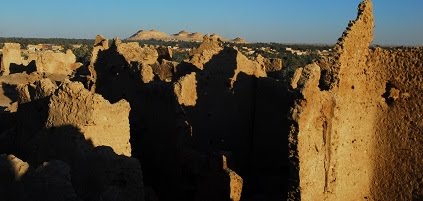
 Siwa is very photogenic and its mud based architecture is always interesting.
This series of photos were taken around the Shali fort in the oldest part of town at sunset casting long shadows in soft golden light.
Several of these buildings are now being renovated by local men trying to get a wife, a few Cairo businessmen for boutique hotels and a couple of expats wanting their own cool villa.


Friday, March 11, 2011
A Eye and a Lens - Mountain of the Dead
 These are the Tombs of Jabal El Mawta – on the Mountain of the Dead, which lie to the north of Siwa oasis. Well over one hundred looted tombs were looted from this rather eerie site. For the full Scooby Doo effect try a midnight walk – try not to fall in any of the more hidden tombs.
These series of shots were taken at sunset where the light diffused in myriad hues across the rock face.


Sunday, March 6, 2011
Alexandria
 the main promenade
I head up to Alexandria from Cairo by train from Ramses Station. A second class ticket costs me E£22 and takes 3 hours purchased on board the train, although faster journeys can make the trip in 2 hours.
With a population of some 4.5 million people Alexandria covers some 20kms of the Mediterranean coastline. With its quality coffee shops and classy restaurants there is very much a European flavour to this picturesque city.
Indeed, although the women are still scarved up, there is clearly a greater tactileness between young men and women than i have seen in Egypt; clearly more liberal attitudes exist in this part of the country.
Originally founded in 332BC by that intrepid Grecian dromomaniac Alexander the Great, unfortunately most of the old parts have been reclaimed by the sea. A great shame really for it was once both a major trading centre and centre of learning. Its ancient library once boasted 500,000 volumes and home of the Pharos lighthouse – one of the Ancient Seven Wonders of the World. Allegedly i hear some of the remaining blocks have been incorporated into the old fort and citadel on the western side of the city.
 the ultra modern new library
The Fort and Citadel at the western end of the promenade (E£25/15 for adult/student) is very picturesque. Built by Sultan Qaitbay in 882AD it is also home to the oldest mosque in Alexandria. It is most photogenic in the late afternoon.


Close to the entranceway of the Citadel is an aquarium at the Oceanographic Centre.
Kom Al Dikka is the only Roman amphitheatre in Egypt (admission E£30/E£15 for adult/student), but i am somewhat disappointed – it’s pretty small.

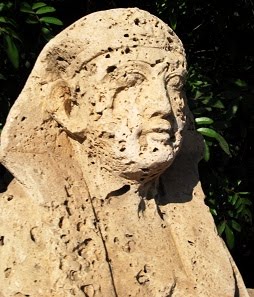

There is also a Roman Villa on site referred to as the Villa of Birds (adult E£15/student E£8) so-called for it’s internal mosaic.

Whilst there are a few other sites around the city, including the Graeco – Roman and National Museums and the Catacombs Of Kom Ash, i am more than content to stroll around town exploring the wealth of coffee shops and patisseries.
My personal favourites include the Brazilian and Sofianopoulo Coffee Stores and Delicies, all to be found on Sharia Saad Zaghloul. And for the best espresso? The Roastery gets my vote on this one – and their red cheddar cheese omelette is pretty good too.
 as much a museum as a coffee shop - the Sofianopoulo Coffee Store
 the mango tart is awesome at Delices'
 For the adventurous divers, Alexandra Dive on the waterfront offers underwater archaeology, although the visibility is usually very poor. You can check out their website by clicking here.
The Tikka Grill on the promenade is somewhat of an upmarket restauran with matching prices but a quality restaurant for carnivores. It can be found on the Corniche.
La Vallee offers passable coffee and Wi-Fi on Midan Ramla.
Getting around is easy enough on foot, but there is also a tram that runs just behind the promenade.
I am comfortably installed at the Crillon Hotel on the waterfront and opt for a large airy room with a sea view for E£98.50 including a filling breakfast. One of the shared bathrooms even has a bath-tub with a plug – my first real bath in Africa!
 Alexandria is famed for its seafood
 just a hint of Greek around town
 the beautiful theatre and opera house
 two tanks park under a landmark on the water-front
 downtown Alexandria
Subscribe to:
Posts (Atom)

