Uganda has been a great place to travel through, not least because it offers cheap options throughout. It also has a variety of outdoor activities to keep the passing travellist satiated. The natural beauty of the country is immense, and with over 1,000 bird species, it is very much an ornithologist’s paradise.
It is green and fertile, and should be self-sufficient. However it has been somewhat reliant on outside aid – indeed almost half of its GNP comes from foreign aid. Really shocking considering the richness that the country has to offer. As Maurice noted, my friend from Fort Portal, he has spent 16 years trying to get the money reduced, but to no avail. They are crippled by love.
The population explosion is enormous, not least witnessed first-hand in Kampala, not least with the strength of Catholicism. The lack of smokers hasn’t helped matters. Fortunately the death-toll on the roads is doing its best to keep the situation under control.
The people have been polite, helpful and friendly without being over-bearing. Again, like Rwanda, shoes are seen as a major status symbol.
Since the far north of Mozambique to this point, i have been regularly assaulted with the ubiquitous “Mzungu” – a label for all “whites”. It has been explained to me on several occasions that it is not an offensive term. It can refer to skin colour, but also as a mode of travelling – zigzagging around. Nonetheless at best it has been a constant irritation and at worst i have loathed it. I don’t shout out in London “oi – Black person!” to every Afro-Caribbean person i meet, although Sue who has been in Uganda for 20 years tells me she responds to the Mzungu call with “Yes, African?” In Jinja t-shirts are available with the words “Mzungu is not my name” – a little too late for me. Fortunately “mzungu” is never heard in Ethiopia, Sudan and Egypt - i morph into a faranji - a foreigner.
My next posting will be from the bowels of Ethiopia. You might have a bit of a wait.
Showing posts with label Uganda. Show all posts
Showing posts with label Uganda. Show all posts
Friday, December 17, 2010


Thursday, December 16, 2010
Onwards and Eastwards - Jinja and Surround
 the source of the Nile - fed by an underwater spring just behind the island on the left
Shit happens on the road. I am disappointed about flight hopping, but it’s time to move on and get on with it.
My flight for Addis departs Uganda on December 18th and i have been faced with a travel dilemma, for hanging in Kampala is not an attractive option for me.
In the north of Uganda lies Murchison Falls where lies a National Park with the cheapest chimpanzee tracking. Unfortunately it is difficult to get there independently, although Red Chilli Hideaway run safaris there. To the east of Kampala lies Jinja – labelled the “adventure playground of Africa” - with bungee jumping, white-water rafting, kayaking, horse-riding and quad-biking all on offer. Unfortunately such fun comes with a price and i am busy trying to mend the hole in my pocket from my flight purchasing.
It’s a shame because the white-water rafting comes highly recommended. A series of Grade Five rapids offers some of the most challenging and adrenalin-filled experiences on the planet. A 250MW hydro-electric dam is scheduled to begin work on February 15th 2011 to reduce these to just four rapids. Both operations that run these rapids (New Zealand run operators Nile River and Ugandan owned Adrift) offer almost identical programmes at an identical US$125 for a day trip and a barbeque. I hear of high recommendations for both. Nile River offer reruns for US$65 and a 2 day trip incorporating 17 major Grade 5 rapids for US$199.
 Grade 5 rapids are on offer close to the source of the Nile
I come for a completely different reason. Just outside the town centre lies the source of the Nile river as i reacquaint myself with Lake Victoria.
Despite the failed attempts of the Greeks and Romans to penetrate the Sudd wetlands in southern Sudan, the upper reaches of the Nile remained largely unknown. Various expeditions failed to determine the river's source, thus yielding classical Hellenistic and Roman representations of the river as a male god with his face and head obscured in drapery. Agatharcides records that in the time of Ptolemy II Philadelphus, a military expedition had penetrated far enough along the course of the Blue Nile to determine that the summer floods were caused by heavy seasonal rainstorms in the Ethiopian Highlands, but no European of antiquity is known to have reached Lake Tana.
Europeans began to learn about the origins of the Nile in the 15th and 16th centuries, when travelers to Ethiopia visited Lake Tana and the source of the Blue Nile in the mountains south of the lake. Although James Bruce claimed to be the first European to have visited the headwaters, modern writers give the credit to the Jesuit Pedro Páez. Páez’ account of the source of the Nile is a long and vivid account of Ethiopia. It was published in full only in the early 20th century, although it was featured in works of Páez’ contemporaries, including Baltazar Téllez, Athanasius Kircher and by Johann Michael Vansleb.
Europeans had been resident in Ethiopia since the late 15th century, and one of them may have visited the headwaters even earlier without leaving a written trace. John Bermudez published the first description of the Tis Issat Falls in his 1565 memoirs, compared them to the Nile Falls alluded to in Cicero's De Republica. Jerónimo Lobo describes the source of the Blue Nile, visiting shortly after Pedro Páez. Telles also used his account.
The White Nile was even less understood. The ancients mistakenly believed that the Niger River represented the upper reaches of the White Nile. For example, Pliny the Elder wrote that the Nile had its origins "in a mountain of lower Mauretania", flowed above ground for "many days" distance, then went underground, reappeared as a large lake in the territories of the Masaesyli, then sank again below the desert to flow underground "for a distance of 20 days' journey till it reaches the nearest Ethiopians." A merchant named Diogenes reported that the Nile's water attracted game such as water buffalo.
Lake Victoria was first sighted by Europeans in 1858 when the British explorer John Hanning Speke reached its southern shore while traveling with Richard Francis Burton to explore central Africa and locate the great lakes. Believing he had found the source of the Nile on seeing this "vast expanse of open water" for the first time, Speke named the lake after the then Queen of Britain. Burton, recovering from illness and resting further south on the shores of Lake Tanganyika, was outraged that Speke claimed to have proved his discovery to be the true source of the Nile when Burton regarded this as still unsettled. A very public quarrel ensued, which sparked a great deal of intense debate within the scientific community and interest by other explorers keen to either confirm or refute Speke's discovery. British explorer and missionary David Livingstone pushed too far west and entered the Congo River system instead. It was ultimately Welsh-American explorer Henry Morton Stanley who confirmed Speke's discovery, circumnavigating Lake Victoria and reporting the great outflow at Ripon Falls on the Lake's northern shore.
Even this activity doesn’t come cheap, USh 10,000 is charged to enter the park. The source spot itself is somewhat disappointing, simply because it is fed by an underwater spring, just behind a small island. Boat trips to the source point and a nearby bat cave can be negotiated.
 how could Dr Livingstone miss this somewhat glitzy signboard?
The park is sponsored by Bell beer and is thus decked out in their sponsorship colours of glitzy red and yellow. There is a statue of one of my all-time heroes ever – Mahatma Ghandi, for some his ashes were placed in the water here in 1948.
 Ghandi - one of the first to ride the rapids of the Nile
The river stretches north for some 4000kms until it exits into the Mediterranean and each particle takes between 3 – 4 months to complete the journey.
I will meet the Nile again in Khartoum at the confluence of the Blue and White Niles and it will be with me ever present companion through the rest of my African Adventures.
Based at Explorer’s Backpackers they offer free shuttles to and from Kampala, with pick-ups outside Red Chilli Hideaway and Nakumatt Oasis. They charge US$5 for a dorm bed and have a reasonably priced menu. They clearly make their money from the rafting. It’s clean and well-maintained and has hot water in the bathrooms. They also offer free wi-fi which for some mysterious reason i am unable to log-on to. They offer mountain bikes, but at US$25 per day is seriously over-priced.
As my Scottish cousin Robin will testify during a stint in Australia, the adrenalin rush from white-water rafting prompts raging hormones, interestingly more often in women. The "cool" Ugandans (many boast American accents) operating from the backpackers are most willing targets, and make the most of the plentiful opportunities that arise. Beds creak, subdued moans break the night silence, and women trip over each other returning to their own bunks at 2am having "gone Native" for a few hours. No wonder the staff here go around with grins larger than the Nile itself.
They have a second back-packers at Bujagali Falls which is some 9kms further out. It is a beautiful site with identical menu and similar prices for accommodation. They also offer safari tents at US$35 per night, but it is a long way out of town. A Boda-boda costs about USH 3,000 to/from town
 the view of Bujagali Falls from Nile Campsite
The town is attractive on the outskirts, but it’s pretty dumpy in the centre and the market literally stinks with huge dumpers filled with disgusting refuse.
The Baraza restaurant opposite the police station offers kebabs, pizzas, Indian and African cuisine. The curries are good, but if you want it to taste authentic, ask for spicy. Non-veg curries cost USh 10,000.
 a Hindu temple on the outskirts of town - appropriately surrounded by cows
Wednesday, December 15, 2010
Golden Oldies in The Mountains of the Moon
Many thanks to Tobes who sent me this interesting article from Uganda's own Daily Monitor newspaper. I'm clearly not the only person to be affected by literature on this unique mountain range. Why am i not surprised that Ms Park is Canadian.
And she gets a free umbrella, cake and t-shirt too! More on this story can be found by clicking here.
30 years ago, Park Beryl read a book about the Duke of Abrussi’s expedition to the highest peak of Rwenzori mountain. There and then, she decided that one day she would climb it, and on November 13, her wish became a reality.
“In the book, it sounded so beautiful so I promised myself that I would climb it. I made up my mind in April this year so I could get done with it before I am too old to climb,” said 78 year-old Park.
Led by guides, Enock Bwambale, Bernard Enanga and Sandra Ampaire of the Rwenzori Trekking Services (RTS), the Canadian lady spent 10 days trekking in mud, snow and over and beneath rocks to reach the highest peak on Mountain Rwenzori. This achievement makes her the oldest person to reach Margherita peak others having been aged 55, 60 and 65 years.
John Hunwick, the Managing Director of Rwenzori Trekking Services, says 10 days is the average number of days it takes for people to climb the highest peak of Mountains of the Moon but it is phenomenal that Park could do that at her age. Bwambale, the chief guide says, “Park has a breathing problem so we had to keep on resting from time to time. It is amazing that she was still able to trek for 10 days.”
Beryl’s hike of the Rwenzori at such an advanced age has been described as historical by officials of the Uganda Wildlife Authority (UWA). While receiving the climber at the RTS campsite in Kilembe, Kasese District, the senior warden in charge of Rwenzori Mountains National park, Mr Fred Kiiza said that Park’s hike of the Rwenzori will remain historical to the Rwenzori. “This old woman has cleared perceptions that have been told about the Rwenzori. People have said it is hard to climb but she managed to reach the peak. Beryl has made us so proud.” Kiiza said.
Beryl says that she stays in a mountainous area and even when she was still a young girl, she used to climb hills and cliffs so she has always been interested in mountain climbing. “While at home, I ski at least five times a week and that is how I manage to stay fit.
To prepare for my trek to Margherita, I hiked many mountains a day all through summer and also went for walks to keep fit. But I don’t work out, I do not like it.”
Apart from the cliffs and mountains in her home area, Park climbed Mountain Kilimajaro twice when she was 36 and 72 together with her 13 year-old-granddaughter.
“Climbing Mountain Rwenzori turned out to be the hardest of all. Whereas the weather on Mountain Kilimanjaro is mostly static, that of Rwenzori varies and that is what made it hard to climb. At some point it would rain a lot and then it snows, becomes dry and so on. It was really difficult and honestly the thought of going back crossed my mind but I told myself I had to get to the top because I had set out to reach there.”
She says that though one would move without watching where they stepped in Kilimanjaro, when it came to Rwenzori, “except for the first and last day, you had to be careful where you stepped and held.”
Bwambale says, “When we started the journey, we thought she couldn’t make it to the top because of her body structure. We reached some stages she would cry but would decide to carry on.”
While sharing her experience about the trekking journey with Uganda Wildlife Authority officials and journalists, a tired looking Beryl said, “I could not believe that there was such a beautiful mountain in the world. There was mist so it was hard to see clearly but it was a beautiful sight.” She added that it was strange to find glaciers on the top of the mountain in a country crossed by the equator. “It felt so great to finally get to the top; I even had my lunch while seated on the glacier.”
She said that she was looking forward to bringing her grand children to climb the Rwenzori or encourage them to come. Beryl, a retired hospital social worker has two sons and six grand children. According to her guide, Bwambale, Park took 19 hours to climb a seven hour journey from Elena hut to Margherita peak. “She was a determined old woman who wanted her dream to come true. And throughout the trek she insisted on carrying her back pack.” Beryl has also gone to see the gorillas in Bwindi National park and the Murchison falls among other sites.
Kiiza said that for more than three decades Rwenzori Mountains have not been trekked by elderly climbers. He handed over a Rwenzori Mountains t-shirt to Ms Beryl as a gift for the courageous trek. At the UWA headquarters she was given an umbrella which has the logo, a map of the mountains and a cake which was made in an image of the mountains.
While giving her these items, Justus Tinigarukayo a representative from the Ministry of Tourism and Trade said, “Ms Beryl has now officially become our Tourism Ambassador in Canada, we hope that she will tell of the beauty of the Mountains of the Moon and encourage other people to come and visit.”
He also challenged everyone to go visit the mountain and climb to the peak. “Margherita will give you an opportunity to see beautiful flowers, birds and snow without having to go out of the country and if a 78 year old could, you too can trek to the top.”
And she gets a free umbrella, cake and t-shirt too! More on this story can be found by clicking here.
Monday, December 13, 2010
Kampala
Much of my time has been spent in Kampala hanging out at embassies and travel agents. Apologies to both Kampala and my Dear Readers for the scantiness of this post and the lack of photographs.
Kampala is not an unpleasant city. Indeed, it is quite picturesque, set on rolling hillsides and boasts a fair amount of greenery. However, it is seriously seriously over-populated and even crossing the roads should be undertaken with much trepidation.
It wasn’t always like this. I meet up with resident Sue, a friend of my ex Jen, who has lived in the city for over 15 years. She says she knew individuals’ license plates cars were so scant in the city. Clearly much change has taken place since those days.
The Ugandan museum is rather decrepit and disappointing for a national museum, but it does have a few interesting sights including traditional styled huts from around the country. Admission is USH2,000 with a student card.
Back-packer accommodation is fairly scant. Most backpackers opt for Red Chilli Hide-away, outside the city centre which once boasted excellent food and friendly staff. Rumours abound that this is no longer the case. Wanting to be close to the action, (well at least embassies and travel agents), i opt for the New City Annex on Dewington Road in the heart of the centre. Singles go from USh 15,000 unattached, doubles for USh 30,000 and triples from USh 45,000. The best of the singles is room 117, for it boasts a window, but is heavily booked out. It;s cheap enough and the location is excellent, but that is about it. Nonetheless it is heavily booked and it is well worth making an advanced booking. Call +256 –(0)775 95 8867.
For restaurants there is a good range to be found, although much more pricey than other parts of the country. In Nakumatt Oasis, the food hall on the 1st floor has a fair amount of options. My personal favourite is Pardis – a Middle Eastern restaurant run by an Iranian ex-pat. Meeting up with Loco Lobo, a quality Israeli who i met earlier in Lake Bunyoni, he swears the falafel rivals anything that he can find in Haifa. High praise indeed. The hummus and chopped lamb rock too.
Next door to Nakumatt Oasis is Garden City. On the ground floor you can find Rancher’s Butcher’s Shop and Grill. The pepper steak is totally delicious but at USh 22,000 it doesn’t come cheap.
In tribute to Boy, i do succumb to Nando’s for an over-priced chicken treat.
Getting around is fairly easy on boda-bodas, but negotiations on prices is compulsory.
Kampala boasts some of the best night-life in Africa, but it’s not my thang.
Kampala is not an unpleasant city. Indeed, it is quite picturesque, set on rolling hillsides and boasts a fair amount of greenery. However, it is seriously seriously over-populated and even crossing the roads should be undertaken with much trepidation.
It wasn’t always like this. I meet up with resident Sue, a friend of my ex Jen, who has lived in the city for over 15 years. She says she knew individuals’ license plates cars were so scant in the city. Clearly much change has taken place since those days.
The Ugandan museum is rather decrepit and disappointing for a national museum, but it does have a few interesting sights including traditional styled huts from around the country. Admission is USH2,000 with a student card.
Back-packer accommodation is fairly scant. Most backpackers opt for Red Chilli Hide-away, outside the city centre which once boasted excellent food and friendly staff. Rumours abound that this is no longer the case. Wanting to be close to the action, (well at least embassies and travel agents), i opt for the New City Annex on Dewington Road in the heart of the centre. Singles go from USh 15,000 unattached, doubles for USh 30,000 and triples from USh 45,000. The best of the singles is room 117, for it boasts a window, but is heavily booked out. It;s cheap enough and the location is excellent, but that is about it. Nonetheless it is heavily booked and it is well worth making an advanced booking. Call +256 –(0)775 95 8867.
For restaurants there is a good range to be found, although much more pricey than other parts of the country. In Nakumatt Oasis, the food hall on the 1st floor has a fair amount of options. My personal favourite is Pardis – a Middle Eastern restaurant run by an Iranian ex-pat. Meeting up with Loco Lobo, a quality Israeli who i met earlier in Lake Bunyoni, he swears the falafel rivals anything that he can find in Haifa. High praise indeed. The hummus and chopped lamb rock too.
Next door to Nakumatt Oasis is Garden City. On the ground floor you can find Rancher’s Butcher’s Shop and Grill. The pepper steak is totally delicious but at USh 22,000 it doesn’t come cheap.
In tribute to Boy, i do succumb to Nando’s for an over-priced chicken treat.
Getting around is fairly easy on boda-bodas, but negotiations on prices is compulsory.
Kampala boasts some of the best night-life in Africa, but it’s not my thang.
Sunday, December 12, 2010
An Overland Adventure?
I have hit a rut and i am not a happy bunny.
Africa is a totally cool continent, but is also a much screwed place also. Having been exploited by others for over 13 centuries, it needs to unite.
It should be easy to travel across the continent, but it appears to be so difficult to make the journey overland without more advanced planning that i have been able to accomplish.
I knew Kampala was going to be an important city for me. Rumours abound of a tightening of restrictions, most especially for UK and German citizens for Ethiopia. I also need to procure a visa for Sudan, usually uncomplicated for over-landers heading south from Egypt, but notoriously difficult for traveller heading South to North. Kampala has both Sudanese and Ethiopian Embassies, and i know i am looking at several days trying to overcome these bureaucratic hurdles.
There are two embassies for Sudan in Kampala, one for Sudan and one specifically for South Sudan – somewhat bizarre, especially as the referendum is not scheduled for 12th January 2011.I head to the main office on Nakasero Road, and unbelievably strike gold. Wednesday is THE day for processing visa applications. The two sided application form is somewhat confusing – for a start it is a poor photocopy and most of it is in Arabic with the occasional word in English relating to boxes which don’t appear to have any relation to the question asked. Indeed, i get even more spooked by the second side, which asks me who my sponsors are both internally and externally. I have none, so rather than try to blag it i simply leave these parts empty. I hand it over with some trepidation, but the diplomat seems unconcerned and request me for my passport and USh 55,000. I am told it will be ready for collection the following day. I request a receipt for my passport, which they seem unable or unwilling to provide, but they tell me just to hand the passport next day. I am delighted by the ease the process seems to have taken.
Not all is shiny the next day however. My passport is handed in, but it takes more than two hours to get the visa stamp. I have a visa but it is only valid for a two week period. I politely suggest that 2 weeks in not going to give me an comprehensive insight to their wonderful country, but i am politely told this is a standard issue.
I will look at getting an extension to this in Ethiopia or if not in Khartoum itself.
My trip to the Ethiopian Embassy is far less successful. Hidden off Nakayima Road close to the Kitante Channel, i am greeted by a woman with virtually no English skills who does not understand my request for a visa. After 10 minutes of a farcical attempt to explain my request to her, including doodles and mimes, she eventually calls for help. Problems have broken out between UK and Ethiopia, and here in Kampala i am informed that unless i am prepared to send my passport to UK via a friend, get it stamped at the Ethiopian Embassy and then resent out to me here in Kampala, i will have to fly into Addis.
I am saddened by this news – i so wanted to complete this adventure overland. I run around several travel agents getting quotes for a one-way ticket from Entebbe. Having found a reasonably priced option after three days scouring the city, i go to pay some US$355 to be told that unless i can show an onward airline ticket from Addis, permission for a visa will be refused.
I am thus faced with buying a return flight to Kampala or to book an additional flight onwards. Wary that i have only a two week visa in Sudan, i opt for a flight onto Khartoum. All very well, but then i am requested to show an onward flight out of Sudan. I show them my visa already in my passport, but this is not acceptable.
By this stage i have had enough. I purchase a ticket Entebbe (Uganda) to Addis (Ethiopia) to Khartoum (Sudan) to Uganda (which will go unused). I am some US$700 out of pocket and i feel like crying.
Africa is a totally cool continent, but is also a much screwed place also. Having been exploited by others for over 13 centuries, it needs to unite.
It should be easy to travel across the continent, but it appears to be so difficult to make the journey overland without more advanced planning that i have been able to accomplish.
I knew Kampala was going to be an important city for me. Rumours abound of a tightening of restrictions, most especially for UK and German citizens for Ethiopia. I also need to procure a visa for Sudan, usually uncomplicated for over-landers heading south from Egypt, but notoriously difficult for traveller heading South to North. Kampala has both Sudanese and Ethiopian Embassies, and i know i am looking at several days trying to overcome these bureaucratic hurdles.
There are two embassies for Sudan in Kampala, one for Sudan and one specifically for South Sudan – somewhat bizarre, especially as the referendum is not scheduled for 12th January 2011.I head to the main office on Nakasero Road, and unbelievably strike gold. Wednesday is THE day for processing visa applications. The two sided application form is somewhat confusing – for a start it is a poor photocopy and most of it is in Arabic with the occasional word in English relating to boxes which don’t appear to have any relation to the question asked. Indeed, i get even more spooked by the second side, which asks me who my sponsors are both internally and externally. I have none, so rather than try to blag it i simply leave these parts empty. I hand it over with some trepidation, but the diplomat seems unconcerned and request me for my passport and USh 55,000. I am told it will be ready for collection the following day. I request a receipt for my passport, which they seem unable or unwilling to provide, but they tell me just to hand the passport next day. I am delighted by the ease the process seems to have taken.
Not all is shiny the next day however. My passport is handed in, but it takes more than two hours to get the visa stamp. I have a visa but it is only valid for a two week period. I politely suggest that 2 weeks in not going to give me an comprehensive insight to their wonderful country, but i am politely told this is a standard issue.
I will look at getting an extension to this in Ethiopia or if not in Khartoum itself.
My trip to the Ethiopian Embassy is far less successful. Hidden off Nakayima Road close to the Kitante Channel, i am greeted by a woman with virtually no English skills who does not understand my request for a visa. After 10 minutes of a farcical attempt to explain my request to her, including doodles and mimes, she eventually calls for help. Problems have broken out between UK and Ethiopia, and here in Kampala i am informed that unless i am prepared to send my passport to UK via a friend, get it stamped at the Ethiopian Embassy and then resent out to me here in Kampala, i will have to fly into Addis.
I am saddened by this news – i so wanted to complete this adventure overland. I run around several travel agents getting quotes for a one-way ticket from Entebbe. Having found a reasonably priced option after three days scouring the city, i go to pay some US$355 to be told that unless i can show an onward airline ticket from Addis, permission for a visa will be refused.
I am thus faced with buying a return flight to Kampala or to book an additional flight onwards. Wary that i have only a two week visa in Sudan, i opt for a flight onto Khartoum. All very well, but then i am requested to show an onward flight out of Sudan. I show them my visa already in my passport, but this is not acceptable.
By this stage i have had enough. I purchase a ticket Entebbe (Uganda) to Addis (Ethiopia) to Khartoum (Sudan) to Uganda (which will go unused). I am some US$700 out of pocket and i feel like crying.
Thursday, December 9, 2010
Hanging Out with Aubrey
 view from the veranda of Lake N'Dali
After my first encounters with an Aubrey in Malawi, i finally get to meet an English Aubrey in Fort Portal. He informs me he runs the N’Dali Lodge close to Lake Nkuruba and invites me to visit.
The estate is immense – like a film-set for a Somerset Maugham classic. Set up by his grandfather, an English tea and coffee grower, the estate was taken over by Aubrey’s father, before being booted out by Idi Amin. Nonetheless, he returned again and built the lodge in the 1990s. Unfortunately, he died prematurely, and Aubrey relocated from Scotland to take over this deluxe lodge. It overlooks three volcanic lakes, has some awesome guest cottages and a swimming pool.
 a stolen road-sign - a present from a friend
His new young black wife was born in Uganda, relocated to Australia aged two and then re-relocated to New York. Nonetheless she sounds like the Queen of England. She talks about her plans to bake scones the following day.
I am invited out onto the wooden veranda, where baked chicken in yoghurt sauce is served up with a wild variety of salads. Krest bitter lemon is served by the butler with ice (my first since South Africa) and i half expect Pimms with lemonade to be brought out too. The veranda overlooks an immaculate garden, with beautiful fresh blossoming flowers.
The guests add further to the atmosphere too, for they are kitted out in perfect safari khaki.
It’s all bloody weird and extremely strange.
Wednesday, December 8, 2010
Lake Nkuruba and Surrounds
 the most attractive crater lake in the World?
Lonely Planet "Africa" claim this to be one of the most beautiful crater lakes in the World.
Having witnessed first-hand the three crater lakes of Keli Mutu on Flores, Indonesia, this is somewhat fanciful, but nonetheless it is a beautiful spot. Surrounded by primary forest, this small lake is superb, and both the bird-life and monkey colonies are rich.

 Is there a more attractive primate than the Colobus monkey?
 Vervet monkeys generally live in peace with the Colobus
There are two accommodation options, both somewhat cheekily called Lake Nkuruba Nature Reserve and Community Camp-site. I’m staying at the original (and signposted as such). With bandas ranging from Ush16,000 to USh 50,000, i opt for the beautiful lakeside cottage for USh 30,000. It is picture perfect and i am amazed why this is not everyone’s first choice option. Camping is also available.
The cottage offers the only direct views of the lake, and the night sounds are immense. With fig trees behind the cottage, monkeys, both Colobus and Vervets will come and hang out, as well as drop twigs and other debris on the corrugated iron roof to wake you in the morning.
 the lakeside cottage - the choicest accommodation option on Lake Nkuruba
They offer a variety of activities including, bike rents, motorcycle rides, bird-watching, trips to Bigodi and Kinigami swamps, village tours, waterfall hike and the “Top of the World.”
 local kids
 happy banana seller
The food is basic but reasonably priced at about USh6,500, but to be honest, only the guacamole tastes good. Fortunately i have brought a few supplies along with me from Fort Portal. Further supplies can be picked up from nearby Rwaihumba.
 Jim at the nearby waterfall
Conditions are pretty basic, with solar electricity only available in the restaurant and just one set of shared toilets.
 evening light
Lake Nkuruba lies some 25kms from Fort Portal and can be reached via shared taxi for USh4,000 or boda-boda for USh7,000.
The surrounding countryside is superb. Out past Rwaihumba are three more crater lakes including N’Dali lake and i spend much of my time hiking alone.
 farm hands
Further afield is Kibale National Park where chimpanzees can be tracked, but i hold off for now, hoping to visit these near Murchison Falls when i head north.
Monday, December 6, 2010
Fort Portal
 the central mosque
My journey from Mweya (Queen Elizabeth National Park) to Fort Portal takes two legs. The fare to Kasese, some 45 minutes away and costs USh3,000. It crosses the Equator line marked by two markers on the highway. It is here that trekking parties depart for The Mountains of the Moon. For me, this would be another voyage in itself, but i jump into a mini-bus for the hour and twenty minute journey to Fort Portal.
The town is quite clean, wide streets and even boasts sidewalks! It also offers spectacular views of the Mountains of the Moon – sounds much nicer to me than the Rwenzori Range.
 unbelievably this is currently a derelict building
On Tin’s recommendation i first check into the Ruwenzori View Guest House, in the green suburb of Boma, run by an elderly British/Dutch couple. After a serious lack of sleep at QENP i feel i deserve a bit of a splurge. I take Room 8, the only non-attached room for Ush40,000 (single/double with attached USh72,000/94,000) including a whopping all you can eat breakfast. I choose to eat dinner in, and although it costs USh24,000, i can honestly say it is the best meal i have enjoyed in Africa. There is a choice of soups, veg. and non-veg. Mains with salad and rice, and an apple crumble and ice-cream dessert accompanied by coffee. The meal is taken family style and non-residents of the hotel, predominantly NGO workers, make for extremely interesting discourse throughout.
Maurice our host has been in Uganda for 16 years and clearly is very knowledgeable about his adopted country. He informs me that Uganda now has the highest road death-rate in the World, and warns of the population explosion taking place in Kampala – the Ugandan population has doubled since the 1991. Scarily, although he swears blind, up until recently locals have been keen to contract HIV. I’m simply blown away by this information, but he informs me that contracting the virus meant priority and high quality medical treatment. NGOs and government aid has provided outstanding improvements to hospitals both in Uganda and indeed further afield, but only if they treat carriers. Now the lists have recently closed, HIV contraction has notably declined.
You can contact Ineke and Maurice for a booking on +256 – (0)4834 22 102
With no MTN phone or Net connection, i decide to check out the accommodation options in town. The Continental Hotel (Lugard Road) has dark and poorly maintained rooms for USh10,000 per single, the Kenneth Inn for USh31,000 (including breakfast) and the smart and comfortable Rwezori Traveller’s Inn (Lugard Road) for USh32,000. I opt for the Visitour’s Inn who offer me a special on their Executive room for USh25,000 (reduced from USh30,000 per night) if i stay 3 days. It’s clean, comfortable and spacious. It can be found on the junction of Lugard Road and Babitha Road.
 cleaning the bike
It is currently “Locust Season” and at 3.18am i am awakened by a plague of these critters invading my room on Biblical proportions. It’s horrendous and hide myself under my mosquito net, and then try and return the beasties out the window in the morning.
For eating options, it is well worth a track up to Boma to dine at Ruwenzori View Guest House. They eat at 8pm and you will need to book in advance.
The Garden restaurant near the main mosque on Lugard is highly recommended, although the bush tucker seems to have disappeared off their menu. A range of Continental and African dishes are available, and assisted by the presence of Heinz tomato ketchup amd American Garden mayonnaise.
The pepper steak and fries is good at Rwezori Traveller’s Inn. The cheeseburger decidedly disappointing. A bit of a personal fave is the Pier Pizzeria and Italian restaurant also on Luard. The pizzas range from USh8.000 – 19,000 but they also offer “Baby” ones for half price which are good for one. There are also pasta offerings and breakfasts available too. The generator is pretty annoying and it is in operation every time i visit.
For grocery treats, head to Andrew and Brothers where olives, gouda cheese and a variety of other goodies can be obtained.
The bric-a-brac market by the bridge is somewhat shabby and has little interest for the passing travellist.
There are ATMs in town, but the electricity supply is highly sporadic and often out for huge periods throughout the day.
Wednesday, December 1, 2010
Queen Elizabeth National Park
 There are probably several reasons to explain my dromomania, not least being born in Watford.
Ma puts it down to the Willard Price Adventure books i read as a child. Hardly classics, they did provide me with interesting insights into countries and the indigenous natural environment. She might be right!
Of all of them, and there were at least 13 of the series, it was Elephant Adventure that remained the most memorable with its setting in the almost legendary Mountains of the Moon – known locally as the Rwenzori Range.
This mountain range forms the backdrop to Queen Elizabeth National Park on the western ridge of the Rift Valley. Although quite small, some 1978 square kilometres , its biodiversity is huge, with some 95 species of mammals, including elephant, hippos, lions and leopards, and over 610 species of birds. There are also 57 vegetation types.
 one of the 95 mammal species - the striped mongoose
 elephants at dawn
Established in 1952 and inaugurated by Queen Elizabeth in 1954, the park offers grasslands, bush grasslands, Acacia woodland and lakeshore/swamp vegetation.
 a buff cools off
It takes me almost three hours to reach Katanguru Bridge on the main highway from Mwarara in a shared taxi costing Us15,000. I am met by a local driver Jeffrey who offers me a ride into the park. He also informs me he is a local guide and can offer me a four hour drive safari in his Toyota sedan. I haggle hard and we finally agree on transport in and out of the park, plus the drive safari over my three consecutive days for Us130,000. Jeffrey can be reached by calling 0773326270.
 the ubiquitous warthogs
I am based at the Student Camp run by Robert who has been working here for some 10 years, This is the cheapest accommodation option in the park and takes some persuading to get myself admitted. At first i am told it is for students only, so i swiftly produce my ISIC student card. He then informs me he as a group of students who will be arriving in later and it will be too noisy for me. I assure him this is not a problem – indeed this is one of the reasons i carry an MP3 player with me. He then informs me i will need a lock, a torch and a sleeping bag, and seems somewhat disappointed that i possess all three. He grabs a rather shabby foam mattress and a pillow and shows me to a dorm at the far end of the site. He also advises me not to leave any valuables in the dormitory, which means not just carrying the Beast with me at all times, but also the laptop and MP3 player.
 the beautiful Ugandan kob - a sub-species of impala found only in Uganda, Rwanda and DRC
The dorm is okay, although stifling hot inside. Although there is no plug socket for charging either my lap-top or camera batteries, it has a light inside. The students arrive in about 10.30pm, are loud and noisy, boast a shoddy sound system that they turn to max, and stay up all night because they are scared. I don’t have the balls to complain. It continues through the following night too.
 a multicoloured lizard hanging out on the outside wall of my dorm room. One managed to sneak in too!
The Student Camp is the cheapest option to stay at Queen Elizabeth National Park, unless you decide to camp. There are three camp sites in the park charging USh15,000 per person per night, but only one of these offers shower and toilet facilities. Whilst the showering compartments are basic at the student camp, the toilet cubicles are unbearable. I am thus forced to piss in the woods and shit at the neighbouring Temba Canteen.
 weaver bird doing what comes naturally
There are two alternative accommodation options at the Mweya – the main site. The extremely plush Mweya Lodge which charges US$130/280, bed and breakfast or full board US$155/US$280, single/doubles. Deluxe rooms, suites, Royal Cottage, Presidential Cottage and Queen’s Cottage are also available from US$270 – 750 per night. Given the prices charged for their food (USh50,000) evening buffet and the alternative food available at the site, it’s probably worth going full board.
The Mweya Lodge is a quite nice option, with non-attached rooms for USh57,000/84,000 (single/double). The on-site restaurant is quite good with mains USh8,000 (veg), USh 12,000 (non-veg).
The Temba Canteen does breakfasts for about USh5,000 and mains from Ush6,000 – Ush8,000. It’s basic but okay.
PARK TARIFFS 2010:
Park Entrance Fee (per 24 hours: US$30/US$25/US$20 (Non-residents/students/residents
Available activities include:
Boat Cruises – four times a day – 2 hour duration – 9am, 11am, 3pm, 5pm US$15 minimum 10 people. The 3pm trip is by far the most popular.
Guided Walks – twice a day – 2 hour duration – US$10
Guide for Nature Drives – own vehicle required – 3 and a half hours – US$20
Further afield – Chimpanzee tracking at Kyambura Gorge – twice daily – 8am and 2pm – US$50
Primate Walks at Maramgambo – US$10 any time
I opt for the boat cruise and the morning guided walk during my stay. The tour is crammed with two separate tour parties, one a bunch of 30 something British women, possibly a Lesbian group judging by both their appearance and behaviour, and a group of retired Italians who are doing a two week tour of Uganda, Rwanda and Burundi. They are accompanied by a 30 something marginally attractive Ugandan woman, and despite the wild-life on offer is very much the focal point of the elderly male Italians, much to the disgust and disapproval of the womenfolk.
The boat cruises up the Mweya Channel offering sightings of plenty of hippo, extensive birdlife, wallowing buffaloes and even a few crocodiles.
 a wallowing hippo as seen from the boat cruise
 a young croc sun-bathing
I am the only person taking up the offer of the guided walk. I am accompanied by my armed guide Moses, who has a clear love of Premier League football, the English (he spent two months on an exchange programme in Hampshire on the south coast of England) and wild-life in general. He is clearly very knowledgeable on all three areas, and the walk is pleasant enough, but apart from a few birds, a male waterbuck and heap-loads of hippo shit there is not much to see.
In Ishasha, sightings of tree-climbing lions are often spotted.
There are some 11 fishing communities living inside the park, One of these communities was regularly visited by a man-eating lion which was eventually shot and can now be seen seen in the Visitors’ Information Centre. They are helpful and polite, and apologize for the parks poorly managed website which includes a non-functioning telephone number, and their inability to respond to emails. I am assured they are currently in the process of updating it.
Given the wild-life on offer, the accessibility of the place and the prices charged, Queen Elizabeth National Park offers good value for money.
waterbucks - male and female


The Seriously Ugly Maribou Stork

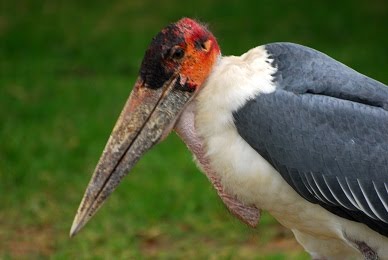
 can the knowlegeable Bubba name this little beauty?
The Majestic African Fish Eagles
 Did You Know:
• The life-span of the African Fish Eagle is about 50 years
• The male and female can only be distinguished when seen together – the female is larger
• The couple mate for life – on the death of their partner, the eagle will not find another
• The couple never share their food
An Eye and a Lens - Buffaloes in QENP
 I love buffaloes! They looks so awesome. Unfortunately these gorgeous creatures are plagued by flies day and night which not surprisingly cause them major irritation.
Thus they spend alot of their time in water or indeed by rolling in mud to try and protect themselves from this horrible plague of pesky parasites.
These were taken with my 70 - 300mm lens in Queen Elizabeth National Park in Uganda.


Saturday, November 27, 2010
Mbarara
 I am in a personal rebellion against long bus rides at the moment.
I therefore break up my journey between Kabale and Queen Elizabeth National Park at the town of Mbarara, a name i have total difficulty pronouncing.
It’s not particularly interesting, but does have a few good restaurants and a quirky feel to the place. Check out the lane behind High Street and you’ll find an alley of chiropodists operating off small wooden crates.
Probably the best restaurant in town is the City Top restaurant at the heart of the town centre on Main Road, offering a hearty selection of snacks and mains and boasting an African, Indian and Continental menu. Fridays are their chicken Biryani Special day. Their chicken tikka masala is pretty tasty too.
Or a cheaper alternative you could do worse than check out the Hot Spot restaurant. It can be found off Main Road at the Barclay’s Bank turn-off.
It is election time here in Uganda (not dissimilar to my journey through Tanzania) and there are continuous parades going through the town centre with loud music and honking horns continually as all three parties contending here trying to outdo the other.


Uganda is enjoying a rare period of political stability. Multi-party democracy was only secured in 2005.

Ever wondered what happened to that big fat bastard Idi Amin who murdered some 300,000 Ugandans? He fled to Libya in early 1979 and eventually died in Saudi Arabia in 2003.
With so much action going on along Main Street, i check into Bena Guest House also on Main Street but further away from the town centre. It is a clean and comfortable en-suite room with lashes of hot water, but charges USh30,000 per room including breakfast without a single person discount.
Unfortunately it transpires to be neighbouring an evangelical church that blares monotonous hymns on a Yamaha organ till 11pm.
There are a couple of ATMs in town.
Thursday, November 25, 2010
Lake Bunyonyi
 If Peter Jackson got turned down by the New Zealand government to film The Hobbit, he could have done a lot worse than to relocate to Lake Bunyoyi in southwest Uganda.

A boda-boda (motorcycle taxi) takes me from the Kabale town centre for USh5,000 to cover the 9kms to the lake. I want to stay at the highly recommended Byoona Amagara Island Retreat, so i drop off at Rutinda Market pier.
Unfortunately i meet Sam – a cheating local guide who tells me i have to charter a boat across to the tiny Itambira Island for USh4000. It is actually free if you leave from the Byoona Amagara parking lot right next door to the pier.
 the island is small enough not to get lost - especially with the helpful signposts
The canoe takes some 50 minutes across this tranquil lake, with terraced hilltops shrouded in clouds.
I am greeted by the friendly duo – Junior and Clinton who warmly welcome me and take me around this special facility. There are several other accommodation options, but this is a local community project which always appeals to me.
The accommodation options are aimed more at the budget and independent travellist with camping spots for USh 8,000, quad-tent for USh30,000, big dorm beds at USh13,000, small dorm beds at USh 13,000, Basic GeoDomes for USh16,000 (per person), deluxe GeoDomes for USh 28,000 (per person), wood cabin for USh30,000 per person and Family Cottage at USh40,000 (per person).
I fall in love with the deluxe GeoDome and splash the cash – in high season they charge a person and a half for single occupancy.
 i fell in love with my deluxe geodome - damn the expense
 sunset from my veranda
I do bring a few additional supplies with me from Kabale, although the food is both good and reasonably priced.
They also run a variety of tours, sell handicrafts and offer Internet access – although in this remote location it is both slow and enjoys frequent cut-offs. They also have an extensive video collection which can be ordered for 8pm screening in the library. Admission is USh2,000.
The tiny island has an abundance of different species of flowering plants and is therefore a paradise for ornithologists.
 so many species of stunning flowering plants
 one of several variety of finches
For two blissful days i am not referred to as Mzungu and chill with other travellers. This is something i have rarely done over the last six and a half months. Although a great source of further travel information, i generally preferring the company of locals. This travellist prefers to go local.
A canoe can be arranged for USh3,000 to return you to the Mainland.
Subscribe to:
Posts (Atom)

